


In a radio interview this Saturday, the Secretary of Agriculture, Jorge Solmi, questioned whether the opening of exports of cull cows to China—announced with much fanfare this week by the government—will initially include the stocks accumulated in the freezers of exporting slaughterhouses.
When making the announcement last Tuesday, the new head of the ministry, Julián Domínguez, was clear in stating that the reopening of exports of cull cows to China would also include beef already in stock (from animals slaughtered during these months of restrictions), which he estimated at around 50,000 tons. This, in addition to beef from approximately 140,000 live animals that supposedly remain in the fields and must be sent to slaughter.
However, in an interview with La Red Rural, Solmi was not as conclusive as his superior. The secretary could not even clarify whether the new resolution, which he said was being prepared over the weekend, would include a special permit to export meat from those cull cows to China, including the seven cuts that remain banned until December 31, such as short ribs, flank steak, and round cuts.
“The resolution is being drafted and will be based on the existing decree. This is an additional resolution that we expect to be ready by Monday,” said Solmi.
—Will there be a distinction between beef from already slaughtered cattle and newly processed animals, or will all exports be released?— asked one of the journalists from La Red Rural.
—We are working on that. The reality is that the proposal we received from the producer organizations, validated by INTA and the universities, focuses on approximately 140,000 cows that have not yet been slaughtered. The initial idea was to first open the market for new production (for the cows still in the fields) and then address other schemes later. The focus of the work was to start with the new stock.
This is the interview with the Secretary of Agriculture:
In another controversial statement, distancing himself from the idea that the new leadership of the Ministry of Agriculture seeks to reach agreements with the Liaison Board and move toward a gradual liberalization of exports, Solmi emphasized that beef is considered a “cultural asset” of Argentines, as stated by Domínguez.
“And it truly is. The IPCVA (Argentine Beef Promotion Institute, made up of ranchers and meat processors) also says so. There are IPCVA publications that refer to the cultural value of beef and that ‘the asado unites us,’” said the official linked to Sergio Massa, who was confirmed in his position by the new minister.
In another controversial passage, distancing himself once again from the idea that the Ministry of Agriculture’s new leadership seeks consensus with the Liaison Board and a gradual export liberalization, Solmi reiterated that beef is considered a “cultural asset” of Argentines, as Minister Domínguez stated.
“Indeed it is. The IPCVA (Argentine Beef Promotion Institute, comprised of ranchers and processors) also affirms this. There are IPCVA publications that speak of the cultural value of beef and state that ‘the asado unites us,’” remarked the official linked to Sergio Massa, who was confirmed in his post by the new minister.
In the same vein, Solmi explained that the current administration is focused on resolving an “urgent” situation regarding the beef market. “The reality today is that beef is a cultural value, and it’s not just us saying it — the IPCVA states it as well,” he noted.
According to this perspective, the urgency stems from the fact that the beef currently available would not be sufficient to meet both domestic consumption and export demand, forcing the government to intervene by limiting shipments abroad. “We have the same number of cows as in 1978, while crop agriculture has increased fivefold. Today, we have a system under strain,” explained the secretary linked to Sergio Massa.
Like his superior, the minister, the Secretary of Agriculture believes it is inappropriate to speak of “restrictions” or “bans” or to use what he calls “negative terms.” He claimed that in 2020 Argentina achieved “the largest beef export volume of the entire century” and that “this year will be the second highest,” a statement that is evidently false, as exports in 2019 exceeded the projected figures for 2021.
—The minister said the system cannot handle exports above 24%. How will you manage that?
—We are working from now until December to resolve the current issue. The path forward is to rethink livestock production entirely.
With this reasoning, Solmi sought to highlight the new tools aimed at improving livestock productivity included in the recently introduced Agroindustrial Law that the government plans to submit to Congress, though with no set date for approval. The bill proposes a series of long-term tax incentives (five years, renewable for another five) for livestock producers.
He also emphasized that this week, livestock producers were granted access to Banco Nación’s subsidized credit lines, following the Central Bank’s decision to remove a restriction that affected 38,000 producers, 800 feedlots, and 3,000 dairy farmers. These producers, due to the nature of their operations, needed to hold soybean or wheat stocks. Up until now, the government had considered anyone retaining 5% or more of their harvest as a “hoarder.”
During the interview, the Deputy Minister of Agriculture defended state intervention in regulating exports when necessary and echoed Domínguez’s warnings that these controls could extend to the wheat and corn markets, which are also considered “cultural assets” by the government.
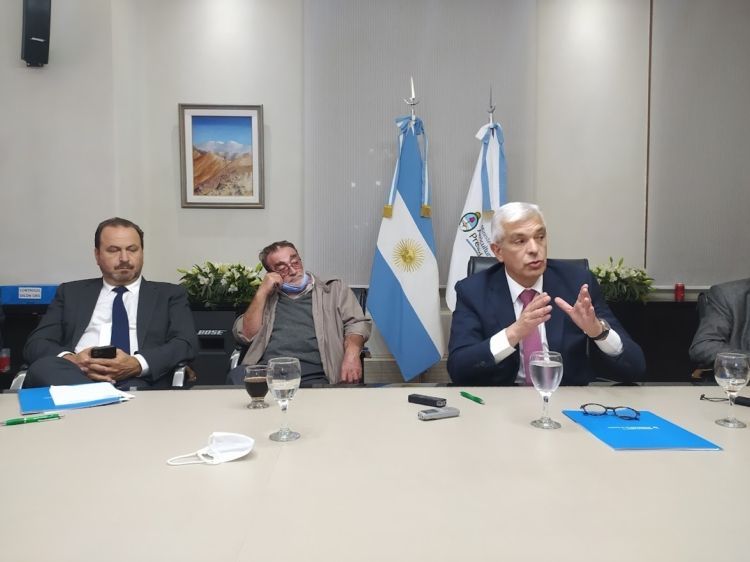

“Free trade, as it is often portrayed, does not exist in the world,” emphasized Solmi, adding that the Ministry of Agriculture continuously monitors wheat and corn exports to ensure they do not exceed the exportable balance established by the authorities.
“We are monitoring, day by day, how export registrations and domestic demand are evolving. And if any decision needs to be made, it will be made,” concluded the official, recalling that in December of last year, corn exports were temporarily suspended “and nothing happened.”
Source: bichosdecampo.com